


Payday is a rhythm. Life isn’t. That mismatch is increasingly a workplace issue. According to Zellis’ Financial Wellbeing Report 2025, 92% of UK & Irish employees experienced financial stress in the past year and 89% say it affected their work – undercutting focus, productivity, and communication. Where employers offer “next-gen” tools at the point of pay – things like clearer payslips, real-time earnings visibility, financial education, money tools, and earned wage access (EWA) – optimism about the year ahead rises to 54%, versus 43% for employees overall.
In this article, we’re going to dive deeper into EWA, how it works, how to deploy it effectively and understand why it links to organisational performance.
What is flexible pay?
Earned wage access (also called flexible pay or on-demand pay) lets people draw down a portion of wages they’ve already earned before payday. There’s no interest and no new debt: the amount advanced is automatically reconciled on the next payslip. Well-designed programmes show a real-time “earned-so-far” balance and apply sensible guardrails, (for example, caps at 50%, or limits on frequency) so usage stays helpful rather than habitual.
In practice, the experience is straightforward. Employees work their shifts; the system calculates wages already accrued; they request a portion within the agreed limits; the funds arrive quickly; and the system reconciles everything in the standard payroll run. For organisations, implementation is easiest when EWA is integrated into the existing HR and payroll stack, which reduces IT lift and avoids the reconciliation headaches that can come with bolt-on tools.

Benefits of flexible pay
Flexible pay gives people breathing room when bills don’t align with payday – and enables them to build greater financial resilience. By using flexible pay, employees can bridge the gap between an unexpected expense and payday, reducing a reliance on expensive borrowing such as payday loads, credit cards, bank loans and overdrafts.
Beyond short-term relief, flexible pay supports engagement and retention. When people can ease money stress without taking on high-cost debt, they’re more present at work, and they notice employers who make that possible.
In practice: Two employee scenarios
Now, let’s look at two different example employees and how flexible pay helps them out of a jam without getting them into deeper financial trouble.
*Please note, all rates and calculations are illustrative and individual circumstances will vary. This does not constitute financial advice. The ‘employees’ presented are fictional examples.
Kelly’s car troubles
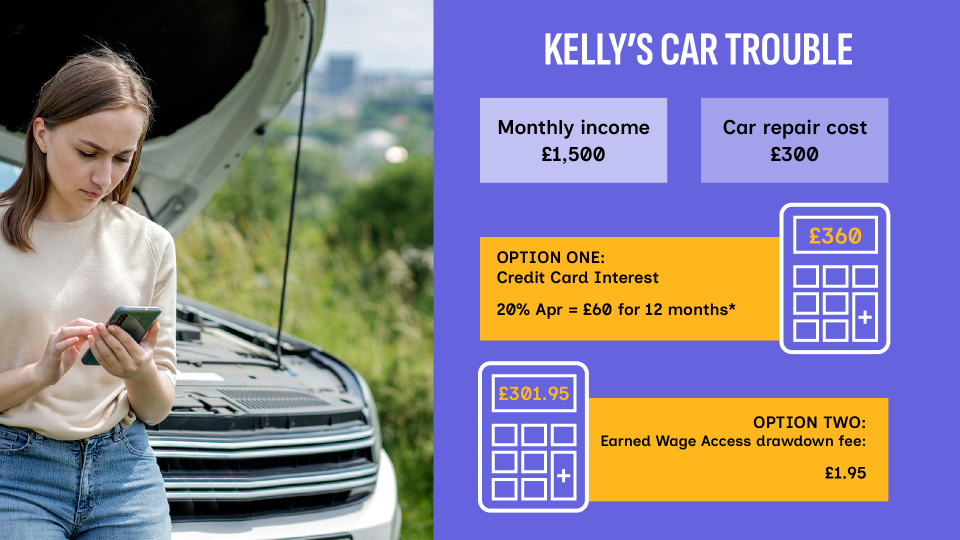
Scenario: Kelly, a retail assistant, earns £1,500 per month
Kelly’s car suddenly breaks down, with repairs costing £300. The car is essential to her day-to-day routine of picking up her kids and getting to work.
Option one: Put the car repair on the credit card
Outcome: Kelly borrows the money and pays it back gradually over the year, as her living costs and family demands mean she can’t afford to pay it back any sooner.
Total cost: With interest of 20% APR, this will cost Kelly £60 over 12 months, and a total of £360, which is 20% of her monthly earnings.
Option two: Flexible pay
Outcome: Kelly has the car repaired and the impact on her work and family life are minimal. She does have to be extra careful with money in the following month but – crucially – manages to avoid high-interest debt.
Total cost: Drawdown transactions cost £1.95 (though employers can choose to absorb this fee). So the repair costs Kelly a total of £301.95.
With flexible pay, Kelly saves £58.05.
Dylan’s dental treatment
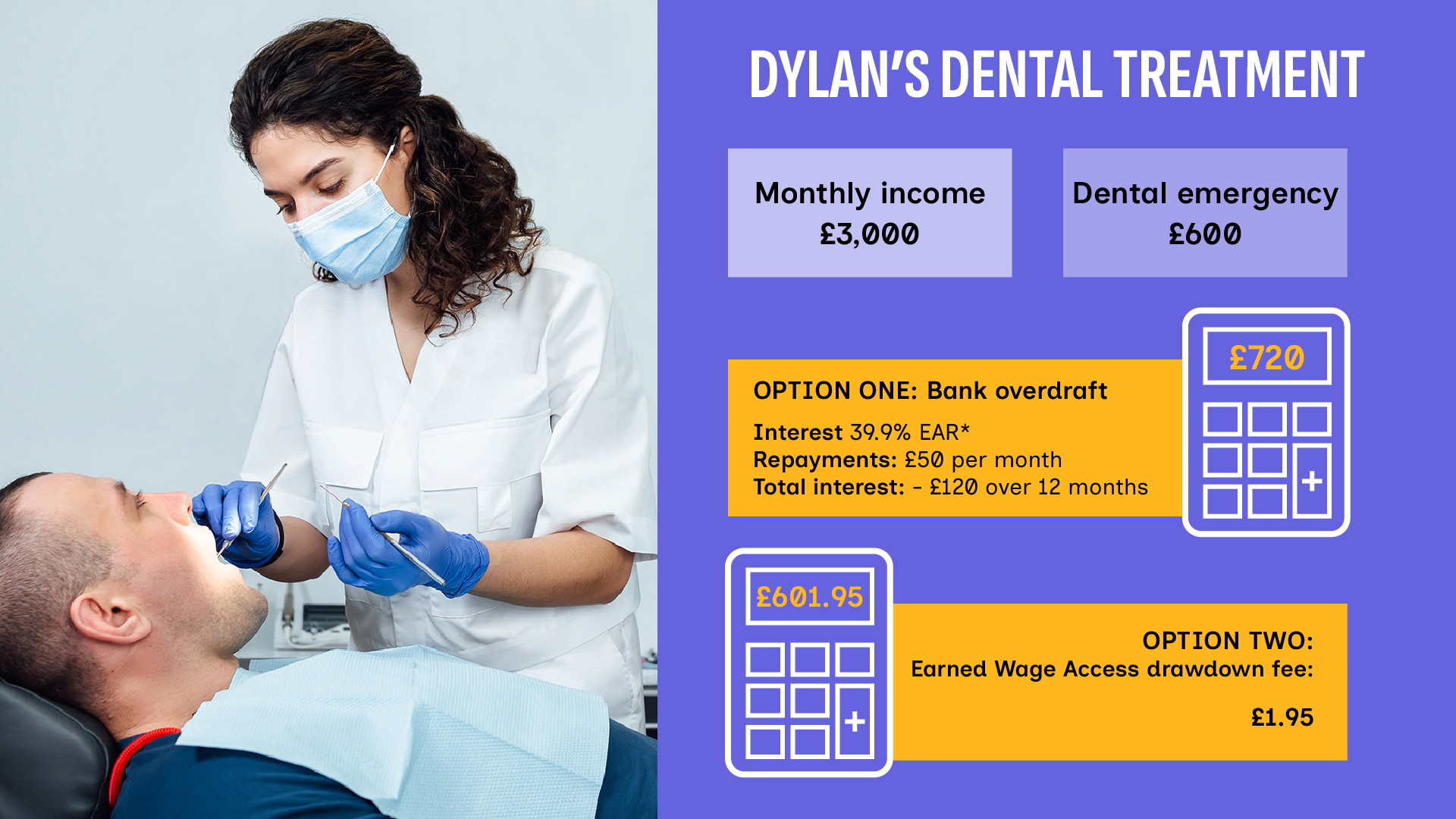
Scenario: Dylan works in an office and earns £3,000 per month
Dylan’s tooth needs urgent attention, but it’s not covered by the NHS. He needs £600 to to get this sorted so he can stop suffering and feel better.
Option one: Use his bank’s overdraft
Outcome: Dylan has no choice but to go into his arranged overdraft. He strives to pay back £50 of the overdraft each month for the following year but still pays a high amount of interest at 39.9% EAR* for total interest of approximately ~£120 over 12 months.
Dylan’s total cost will be £720.
Option two: Flexible pay
Outcome: Dylan accesses £600 of his earned wages via his employer’s flexible pay platform. There is a £1.95 transaction fee. Dylan’s dental woes get sorted with minimal drama, releasing him from discomfort and distraction without putting him in high-interest debt. He is able to absorb the £600 shortfall in the following month by economising and putting off some planned purchases until he’s back on his feet.
Total cost of Dylan’s dental emergency using flexible pay: £601.95.
With flexible pay, Dylan saves £118.05.
*Please note, all rates and calculations are illustrative and individual circumstances will vary. This does not constitute financial advice. The ‘employees’ presented are fictional examples.
What is a salary advance?
A salary (paycheck) advance is an early payment of regular wages before the scheduled payday, arranged by the employer or via a provider acting on the employer’s behalf. The FCA says most Employer Salary Advance Schemes aren’t regulated as credit, but warns that repeated, fee-bearing use can create credit-like harms if poorly controlled.
Think of salary advances as ad-hoc early payments that rely on policy and process, and EWA as a controlled, self-serve feature that wraps access in built-in safeguards – real-time visibility, caps, and automated reconciliation. The best EWA implementations are explicit about what good looks like: tight drawdown and frequency limits, optional cooling-off periods, and in-app budgeting nudges or education to nudge healthier behaviours over time.
Salary advance vs. earned wage access
| Salary/paycheck advance | Earned wage access |
| Early payment of wages – borrowed from future pay Generally not regulated as credit, but can behave like it if fees stack up May involve interest or fees; risk of repeat-use costs Policy-based, varies by employer Typically requires HR approval and manual processing | Access to already-earned wages ahead of payday Does not require a credit check and does not impact credit scores reconciled on payday Typically a low, flat fee (employer can choose to cover), no interest Built-in caps, frequency limits, nudges/education Automated and instant, employees can self serve |
Pros and cons of EWA for employers
The upside – if you design it right
Done well, EWA reduces the timing friction that forces people into overdrafts or short-term borrowing to cover mid-cycle bills, which in turn can translate into calmer workdays and more engaged and loyal teams. Many employers cite positive effects on hiring and retention when EWA is offered as a benefit, and they report fewer “when am I being paid?” queries once employees can see and understand their earnings in real time and draw down within limits.
It also signals care in a way employees actually feel, because it tackles the everyday reality that bills don’t line up neatly with payday. Importantly, the signal is stronger when EWA is part of a broader “next-gen tools” package – clearer payslips, earnings visibility, education and money tools – correlating with that 54% vs 43% optimism uplift in the Zellis 2025 findings.
The risks – and how to neutralise them
The first risk is behavioural. If people can access money any day, some will, and this is exactly why programme design matters: meaningful caps (for example, up to half of accrued earnings), limits on how often employees can draw down in a pay period, and cooling-off periods temper over-use; pairing access with financial education and in-app budgeting prompts keeps the tool from becoming an expensive habit.
The second risk is governance. The CIPP’s EWA Code of Practice sets out what fair value and good outcomes should look like – clear, not-misleading communications; support for vulnerable customers; outcome monitoring; and regular independent assurance of providers. Building that Code into your vendor selection and SLAs is the most pragmatic way to protect employees and your brand. Third, operational fit. Poorly integrated vendors add friction for payroll and HR; choosing an EWA model that plugs into your existing platform keeps reconciliation clean and reduces the chance of downstream errors or avoidable tickets.
What to ask EWA providers
Fees
- Who pays? Are fees flat and capped? Any subscriptions or hidden charges?
- How do you prevent low-paid workers paying proportionally more?
Controls
- Caps (e.g., ≤50%), frequency limits, cooling-off
- Affordability nudges, financial education, and signposting to support baked into the app
Governance
- Who handles employee queries? What are the SLA and escalation paths?
- What reporting dashboards do HR/payroll get – usage quality, repeat-use flags, outcomes, etc
Data
- GDPR roles (controller/processor), data minimisation, retention
- Security: encryption, certifications, and independent audits
Implementation
Organisations considering flexible pay solutions should evaluate several factors:
- Integration with existing payroll systems
- Employee education about responsible usage
- Fee structures and who bears the cost
- Privacy and data security measures
- Metrics for measuring impact on financial wellbeing
- Comms pack; manager guidance; employee education resources
Organisations already using integrated HR and payroll systems have a significant advantage when implementing flexible pay.
By choosing an application that’s built into your existing HR suite, you avoid the complexity of third-party integrations while maintaining complete data security and consistency across your employee management platforms.
Proof of value
- Evidence of usage quality, engagement/retention signals, and reduced payroll queries – not just adoption
EWA is powerful
Combining it with other tools to reduce money stress is even better.
If you want EWA to lift resilience rather than just smooth cash flow, combine it with the other tools employees ask for most at the point of pay. Start with payslip clarity and real-time earnings visibility so people understand what they’re owed and why; add payroll savings via auto-deduction so buffers start building quietly in the background; wrap it in practical education and money tools so employees can make better day-to-day decisions.

Conclusion
When your people feel secure, they work better. When you deliver earned wage access with clear guardrails, transparent pricing, credible governance and tight integration, you ease day-to-day pressure without fuelling debt – and you turn financial wellbeing from a poster on the wall into something people actually feel in their lives and bring back to work. By helping employees to feel more secure, leaders can unlock greater engagement, loyalty, and performance. In this way, responsible pay access becomes not just a financial tool, but a powerful driver of culture, wellbeing, and organisational success.
- Flexible pay allows employees to access already-earned wages before traditional paydays, typically charging only a small transaction fee rather than interest.
- Earned wage access should be part of a comprehensive financial wellbeing strategy that includes budgeting tools and savings programmes.
- These tools help employees avoid high-interest debt while building better financial habits.
- Implementation requires attention to system integration, data security, and employee education.
- Financial wellbeing programmes demonstrate employer commitment to holistic employee support.
Empower your people to thrive
Help your team build better financial habits with MyView PayNow – a comprehensive app featuring flexible pay options, budgeting tools, and payroll savings.